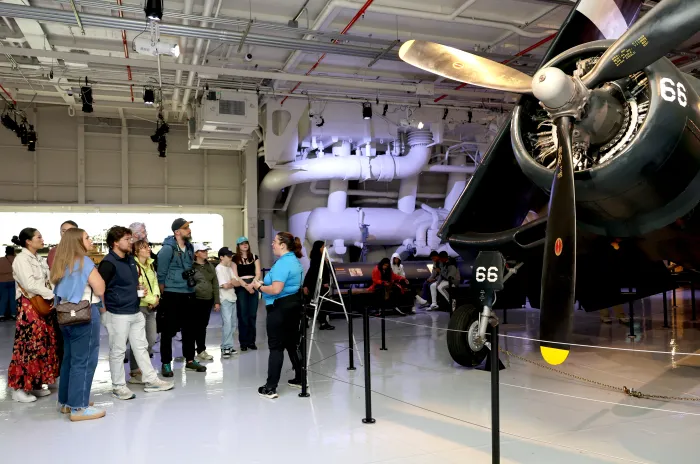
On September 17, 2026, the Intrepid Museum celebrates Space Shuttle Enterprise’s 50th birthday!
Following the Apollo missions, NASA wanted to invest in a new form of space travel and established the Space Shuttle Program in 1972. Formally known as the Space Transportation System (STS), the program aimed to design and implement a reusable spacecraft with the ability to bring larger payloads and more astronauts into space. After considering many shuttle designs, one stood out above the rest: an airplane-shaped vehicle that engineers named the orbiter.
Construction of OV-101, the first shuttle orbiter, started in June 1974. Components for the build came from multiple manufacturers across the United States. By 1976, during the United States’ bicentennial, the prototype’s construction was complete. The orbiter was officially named Constitution.
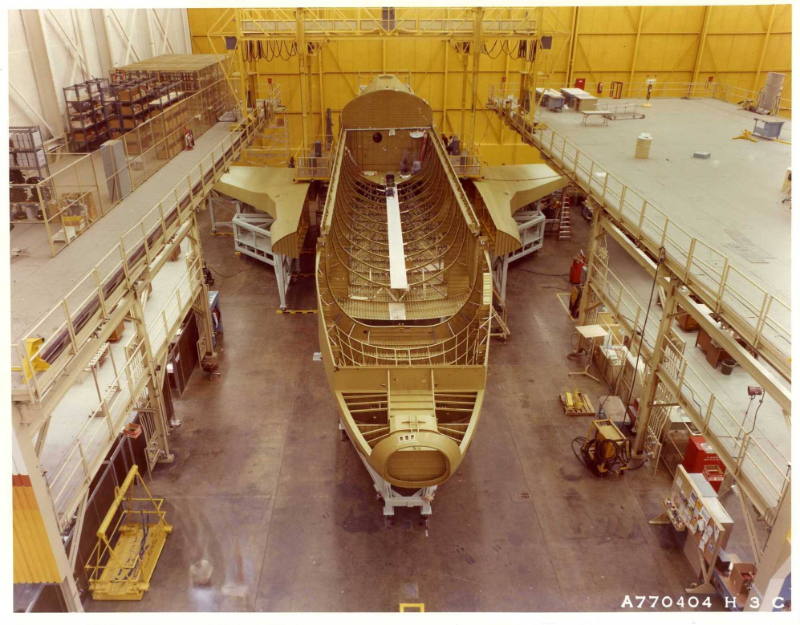
Caption: Enterprise (OV-101) during construction at Rockwell International’s Palmdale Assembly Facility in 1975.
Credit: Collection of Intrepid Museum. Gift of Robert and Sue Ann Dilts. P2011.48.03
NASA planned to celebrate Constitution’s completion with a public roll out ceremony on Constitution Day, the anniversary of the signing of the U.S. Constitution on September 17, 1787. However, the American public had a different idea for the first orbiter’s name. An extensive and enthusiastic community of Star Trek fans orchestrated a massive letter-writing campaign to the White House, urging NASA to name the shuttle after the starship Enterprise from the beloved TV series.
The effort was a success, and NASA changed the designation of the orbiter to Enterprise, to the delight of Star Trek fans. On September 17, 1976, the newly named Enterprise emerged from the Rockwell Air Force Plant 42 in California. Marking the occasion, the creator of Star Trek and most of the original cast attended the roll out. However, while the fictional Starship Enterprise was a fully functioning spaceship on Star Trek, NASA’s Enterprise had a different purpose.
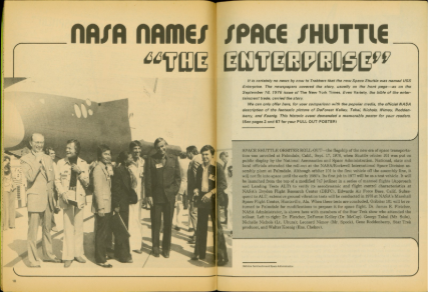
Caption: An article in All About Star Trek Fan Clubs magazine about naming Enterprise and the Star Trek cast at the rollout in 1976.
Credit: Collection of the Intrepid Museum. A2013.67
The new orbiter was built as a test vehicle. Enterprise completed three main experiments: the Approach and Landing Tests (ALT), ground vibration tests and launch setup fit check tests. Arguably the most important of the three, the ALT tests proved that the design could efficiently transport the shuttle orbiters and, more importantly, safely return the astronauts back to Earth.
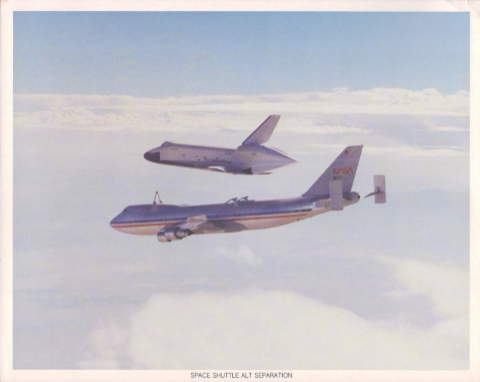
Caption: Enterprise separating from the Shuttle Carrier Aircraft during an Approach and Landing test in 1977.
Credit: Collection of Intrepid Museum. Gift of Karol Bobko. P2016.06.12
Following the lessons from Enterprise’s testing, NASA produced five space-worthy shuttles for the STS program, beginning with OV-102 Columbia’s launch in 1981. After a total of almost 40 years, 135 missions and 355 astronauts, the Space Shuttle Program formally ended in 2011.
Enterprise never went to space, but its lasting legacy and role in space history is undeniably clear. The Intrepid Museum is excited to celebrate Enterprise’s 50th birthday this year and proud to continue to share Enterprise with the world!
Celebrate 50 years of Space Shuttle Enterprise with a special Astronomy Night exploring the past, present, and future of human spaceflight! Admission is free. Register now →