On January 21, 1976, passengers boarded a flight unlike any before it. As Concorde lifted off, it did more than carry travelers around the world. It redefined what was possible in commercial aviation, cutting travel time in half and turning the idea of routine supersonic flight into a reality.
Developed through a historic partnership between the United Kingdom and France, Concorde entered service with British Airways and Air France as the world’s only operational supersonic passenger aircraft. Flying at speeds of 1,350 mph (2,172 kph) and cruising at altitudes up to 60,000 feet (18,288 m), it offered a perspective few had ever experienced. At that height, passengers could see the curvature of the Earth and watch the sky deepen toward black. The experience was as much about status and sensation as it was about speed, with a reputation for attracting business leaders, celebrities, and world travelers seeking to cross oceans in just a few hours.
Despite its technological achievements, Concorde’s story was shaped by complexity. High operating costs, environmental concerns related to sonic booms, and a limited passenger capacity made widespread adoption difficult. After nearly three decades of service, Concorde was retired in 2003. Yet its influence continues to shape today’s renewed interest in high-speed, next-generation aircraft.
That legacy lives on at the Intrepid Museum through Concorde Alpha Delta (G-BOAD). Now on display at the Museum, this record-setting aircraft offers a direct connection to the era of supersonic travel. G-BOAD completed more than 5,600 takeoffs and logged over 16,200 flight hours during its career. On February 7, 1996, it set the record for the fastest transatlantic crossing by a Concorde, completing the journey in 2 hours, 52 minutes, and 59 seconds.
Its final journey to New York marked a new chapter. After its last flight, G-BOAD was carefully transported by river barge from John F. Kennedy Airport to its current home at Intrepid Museum's Pier 86, an operation that transformed a symbol of speed into a striking presence along the Hudson River.
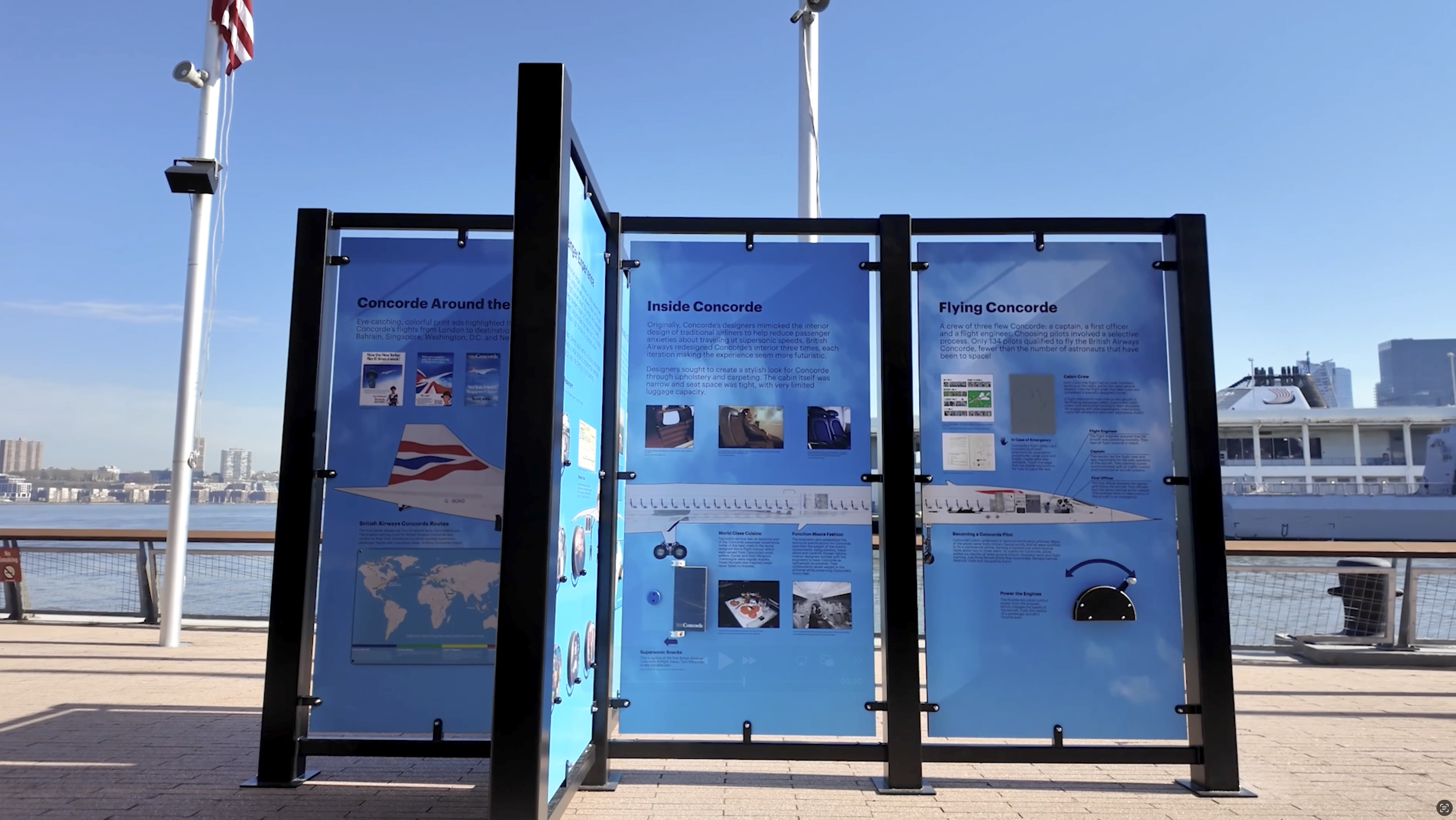
In March 2026, the Intrepid Museum expanded how this story is told with the installation of a new exhibition alongside the aircraft. Through ten panels, the exhibition invites visitors to engage more deeply with Concorde’s history and impact. Tactile elements, including a reproduction in-flight menu and a Braille safety card, provide an accessible way to explore the onboard experience. The content also examines the science of supersonic flight, the realities of crew life, and the distinct culture that defined Concorde travel.
Together, the aircraft and its accompanying exhibition position Concorde not only as a technological achievement of the past, but as a point of connection to the future of aviation. As new efforts to reintroduce supersonic passenger travel gain momentum, Concorde remains a powerful reminder of what innovation can achieve when ambition and engineering align.