Image
Jesse Brown in his flight suit and aviator helmet in the cockpit of an F4U Corsair.

Remembering Ensign Jesse L. Brown

Feb 03, 2026 - 10:00am

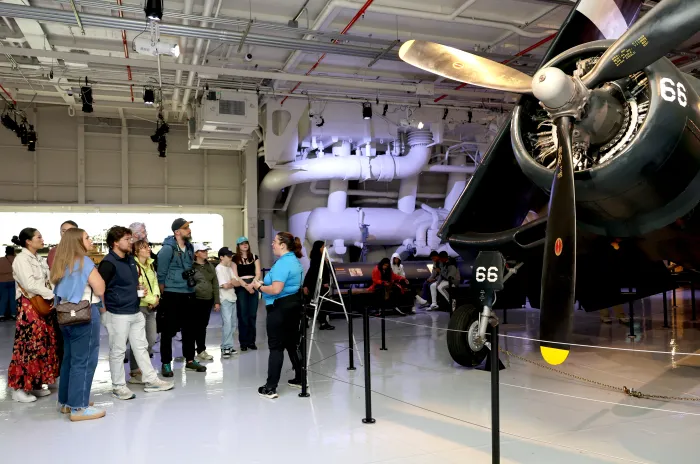
This Black History Month, as we stand beside the Corsair, we remember Ensign Jesse Leroy Brown. Brown was both an accomplished aviator and a pathbreaker, joining the Navy while the service was still throwing off its longstanding practice of racial segregation. A Corsair pilot decorated for his service in the Korean War, Brown’s legacy is deeply connected to the history of naval aviation celebrated at the Intrepid Museum.

Looking to the Sky

Jesse Brown was born in Hattiesburg, Mississippi in 1926. At that time, Mississippi, like other Southern states, practiced racial segregation. These laws and customs sent Black Mississippians to underfunded schools, limited their economic opportunities, blocked them from voting and endangered their lives.

Brown developed a fascination with flight when he was young. He dreamt of becoming a pilot. Brown excelled academically, and with the support of his family and community, he left Mississippi to attend Ohio State University. After he was rejected from the university’s aviation program because of his race, Brown learned about the V-5 Aviation Cadet Program. He began flight training in 1947. When Brown earned his wings in 1948, he made headlines as the first African American aviator trained by the U.S. Navy.

A Naval Aviator at War

Jesse Brown on the flight deck of USS Leyte with VF-32 squadron mates, ca. 1950.

Credit: U.S. Navy photo
Jesse Brown on the flight deck of USS Leyte with VF-32 squadron mates, ca. 1950.

Ensign Brown was assigned to Fighter Squadron 32 (VF-32). He and his fellow pilots flew Corsairs, powerful fighter-bomber aircraft. Recognizable for its trademark bent wings, the Corsair played a pivotal role in World War II and the Korean War. 

VF-32 joined USS Leyte, an Essex-class aircraft carrier like Intrepid. Leyte deployed to the Korean Peninsula shortly after the outbreak of the Korean War. Brown was soon a seasoned combat pilot. He flew 20 combat missions, providing close air support to ground troops in some of the war’s harshest conditions.

On December 4, 1950, during the Battle of Chosin Reservoir, Brown was providing close air support to the Marines when enemy anti-aircraft fire struck his Corsair. Brown crashed in a remote area and was immobilized by his injuries. Despite an attempted rescue, Brown could not be freed from the wreck, and his body was never recovered. Brown left behind a wife and daughter, and a community inspired by his career and bereft by his loss.

A Lasting Legacy

Jesse Brown’s impact extended far beyond his lifetime. He was posthumously awarded the Distinguished Flying Cross. In 1973, the Navy named USS Jesse L. Brown, a Knox-class frigate, in his honor, the first U.S. Navy ship named for an African American.

Brown’s story is one of excellence, resilience, and sacrifice. He did not live to see the generations of Black aviators who followed, but his determination helped make their service possible. Learn more about the service and accomplishments of Black sailors on Intrepid and in the Navy in the Black History Month Highlights on our mobile guide.


Cover Photo: Naval History and Heritage Command
Jesse Brown in his flight suit and aviator helmet in the cockpit of an F4U Corsair.

Image
A man and woman read an exhibit panel on Intrepid's flight deck while their child points at the propeller of an aircraft.
Membership

If you join our membership program you can visit the museum any time! Plus enjoy many membership perks at a discounted rate.