




Intrepid Minute: Growler's Control Room
Intrepid Minute: Growler's Control Room
Join Bil Peters as he takes you into Growler's control room.

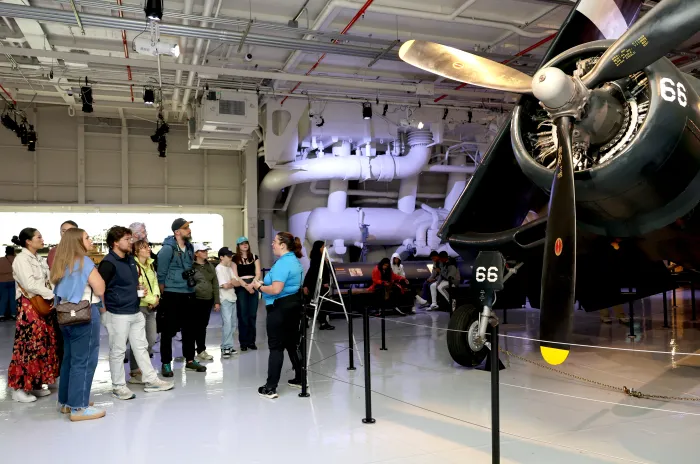
Our expert guides lead fascinating explorations of the Museum and provide greater insight into the historical artifacts on display.

Immerse yourself in the history of the former USS Intrepid with an expert guide who brings the ship’s remarkable service to life. Through key stops across the flight deck and hangar deck, the tour highlights the people, missions, aircraft and technology that defined Intrepid’s unique place in history.
Join one of the Museum’s knowledgeable guides for a 20-minute exploration inside Concorde’s first-class cabin to learn about the technology behind the aircraft.


Go deeper into the storied history of Intrepid, reach for the stars in the Space Shuttle Pavilion, explore the submarine Growler or climb aboard the record-breaking British Airways Concorde—the choice is yours.
Join our expert tour guides and immerse yourself in the history of submarine Growler, take an intimate look inside the British Airways Concorde, marvel at the innovation of the A-12 Blackbird and so much more!
Intrepid Minute: Growler's Control Room
Intrepid Minute: Growler's Control Room
Join Bil Peters as he takes you into Growler's control room.
Hi, I'm Bill Peters. This is another Intrepid Minute. Today we're on the submarine growler. A periscope is the only way to see outside a submarine. It doesn't work underwater, so it extends above the water from a depth of 65 ft or 20 m. On Growler, as with most submarines, we have two periscopes. I call them a pariscopes. The boat requires three people to drive. One steers and follows the direction on a compass. The bow planes controls the actual depth of the boat. Growler is depth tested to 715 ft or 218 m. And the stern planes control the angle at which the boat goes up and
down. They sit here for 6 hours and are given their instructions by a diving officer behind them. These are the youngest people on the boat. Your first job is to drive. And while they sit here, all they have to do is look out the window. There are no windows. To learn more, visit intrepid museum.org. Stay tuned for another Intrepid Minute.
Concorde: Leslie Scott
well it all started the day before when Tim Orchard Rick eids and I uh operated the the the flight to New York we sort of um andard and decided that perhaps on the way back we might attempt uh a record time everything looked as though it was lining up nicely it all looked as though this this was a real possibility we had a pretty fast flight time planned so we thought well this is probably worth a go I remember Tim started the Stockwatch as soon as we got Airborne just to make make sure that we knew what the time was we got great help from Air Traffic Control we were just essentially flying at Mac 2 I didn't do anything
different there other than straightening the route we had some pretty good Tailwinds helping us along we decelerated as late as we possibly could we did all the calculations and I elected to decelerate at the last moment which would have helped us quite a bit I decided to leave The Descent as late as I possibly could from there as well because we were making great time we were doing really well and we descended as rapidly as we could we bided by all the British Airways rules and regulations as far as speed control was concerned I didn't want to do anything too racy this was a commercial flight we touched down 2 hours 52 minutes 59 seconds after we got airborne
Aircraft of the month - A12
The A-12 was the product of Project Oxcart, a secret military program to develop a high-speed, high-altitude reconnaissance aircraft. First flown in 1962, the A-12 was built by Lockheed’s Advanced Development Projects office, now known as Skunk Works. The A-12 was capable of performing sensitive intelligence-gathering missions while flying at speeds over Mach 3, or three times the speed of sound. The Central Intelligence Agency (CIA) used A-12s for surveillance missions until 1968. Later versions, known as the SR-71 Blackbird, served in reconnaissance and test missions for the U.S. Air Force and NASA through the 1990s.
welcome to the flight deck here at the Intrepid Museum today we're going to be talking about a very special plane that's here our Lockheed a12 which is often confused for an SR71 Blackbird a lot of people don't know that the a12 never carried any kind of weapons it was purely for reconnaissance and photography the pilots during this time would use cameras underneath the fuselage in order to take pictures of what was happening on the ground in Vietnam and Korea the a12 could fly faster than Mach 3 because of this and the g-forces that the pilots experienced they had to actually wear space suits
when they were in the cockpit it also flew so fast that the skin on the outside of the aircraft could hit up to 1,000° fah the second a12 ever produced there's actually a black and white photograph of our aircraft sitting on what looks like a telephone pole inverted that was used to test radar at Area 51 thank you for joining me today as I talked about my favorite aircraft here at the Intrepid Museum our H1 off

Enjoy exclusive benefits, including free admission. Learn more and join today.
